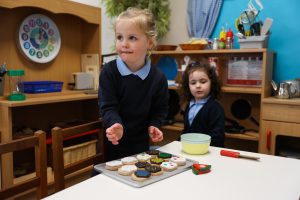
Welcome to Nursery and Reception
Thank you for considering St Paulinus Primary for the next stage in your child’s learning journey and for visiting our website. We hope you find these pages useful.
Ours is a school where children engage in high quality learning through a range of hands on experiences.
The Early Years Foundation Stage curriculum at St Paulinus
In EYFS we strive to provide an exciting and engaging curriculum that inspires awe and wonder and a love of learning in all of our children, providing them with rich and memorable experiences which prepare them for their next stage of learning when they reach Year 1. There, they will have their skills built upon and progression made in a variety of new subjects. Therefore, the role of EYFS is imperative as it underpins all learning and lays the foundations to children’s skills and development in order for them to progress and achieve their maximum potential. We support each child in working towards year one readiness at the end of Reception through deliberately planning opportunities within direct teaching and purposeful provision alongside providing opportunities for children to follow their own interests and initiate their own learning.
At St Paulinus we recognise that the seven areas of learning and development outlined in the EYFS are important and inter-connected. Three areas are particularly crucial for igniting children’s curiosity and enthusiasm for learning, and for building their capacity to learn, form relationships and thrive.
These three areas are the prime areas:
- Communication and Language
- Physical Development
- Personal, Social and Emotional Development
Children are also supported through the four specific areas, through which the three prime areas are strengthened and applied.
The specific areas are:
- Literacy
- Mathematics
- Understanding the World
- Expressive Arts and Design
Our tailor made EYFS curriculum is based on the Statutory Framework for the EYFS (2021) and is flexible in content and theme depending on our children’s needs and interests. The non-statutory guidance from Development Matters document (2021) is also used to support the implementation of the requirements of the EYFS. Our curriculum has also been developed in line with the rest of the school. This ensures that learning over time is sequenced effectively and there is progression; within the EYFS and then on into Year 1.
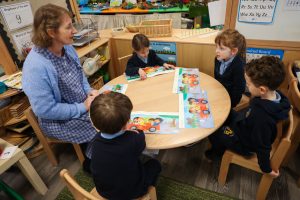
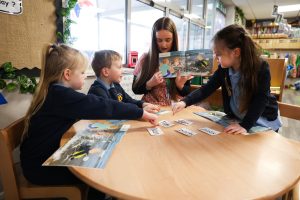
EYFS (Early Years and Foundation Stage) Curriculum
At St Paulinus, we believe that the Early Years Foundation Stage is crucial in securing solid foundations that children are going to continue to build upon. It is our intent that the children who enter our EYFS develop physically, verbally, cognitively and emotionally whilst embedding a positive attitude to school and learning. We believe that all children deserve to be valued as an individual and we are passionate in allowing all children to achieve their full, unique potential.
Intent
We deliver an engaging, creative and high quality curriculum that inspires and challenges every child in our care. Our curriculum is taken from the Educational programmes and provides the framework from which every child in our setting can make progress. Imaginary We ensure that every children’s natural creativity and curiosity can flourish alongside the purposeful acquisition of knowledge.
The Early Years Curriculum is reflective of our whole school values, underpinned by the Gospel value of ‘Love one another as I have loved you’. As a Catholic school our values remain at the heart of our school’s ethos and have a real and significant impact on our curriculum. We believe our values promote well-rounded, happy individuals ready to succeed in an ever changing world. The addition of our local Catholic Church on our school sites allows for regular visits and opportunities to integrate this experience
Our curriculum is developed to fully prepare the children for the next stage in their learning journey. We have developed a curriculum that ensures our children are ready for Year 1 by developing independence and resilience as well as a thirst for learning. It provides opportunities for children to make seamless transitions so that the children are well prepared to tackle the challenges they will face in the next phase of their education and have future success in their next steps as learners.
We are fully inclusive and aim to gain a good understanding of what makes each child unique, learning how we can support and develop each individual child to reach their full potential. Most of our children are from a small market town at the foothills of the North York Moors and we recognise that we are preparing our children to become citizens in a much wider and more diverse world. We recognise the importance our curriculum has in this preparation for the future and aim to provide opportunities for the children to develop positive attitudes around the differences between people, learning about other cultures and ways of life.
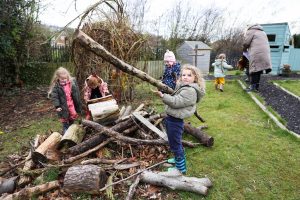
The position of our school in the community allows for a wide range of outdoor learning opportunities. We have extensive school grounds including wooded areas, a well established pond and a natural landscape. We are also in walking distance of a large local woodland which allows for regular trips enabling us to experience first had the changes in the seasons and the natural world on a grand scale.
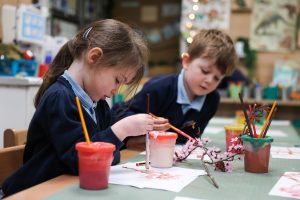
After conducting research linked to developing our children’s progress in early writing, we recognised that providing children with a wide variety of high quality, regular and imaginative artistic experiences had a significant impact on their development of understanding, self-expression, vocabulary and fine motor control. We have recognised the value of art in all of its forms not only in developing the children’s imagination and creativity but also in their ability as writers as well as improving their mental health.
We have the highest expectations for all learners. It is our vision that all aspects of our provision should be accessible to every child. Our inclusive curriculum offers all individuals the chance to showcase their passion and strengths. Opportunities are given for children to develop individual interests.
Language acquisition underpins all aspects of our curriculum and we have chosen high quality texts which we use as our inspiration for teaching and learning. We have a curriculum that is driven by key objectives chosen for groups of children to make sure that every child makes progress in their learning journey. Our learning environment is fundamental to achieving our curriculum intention and our enquiry based approach to teaching and learning, gives the children opportunities to develop, consolidate and deepen their knowledge, understanding and skills across all areas of learning. This is delivered through a combination of child led and adult directed teaching. We also use ‘in the moment’ planning and assessment to develop children’s immediate next steps for learning.
We intend to support each child to develop into an independent, lifelong learner with the resilience to achieve their aspirations and ambitions. At St. Paulinus we are passionate about promoting self motivated learners who love the challenge and adventure of learning. In the Early Years, we recognise our role is to instil positive attitudes that will last a lifetime.
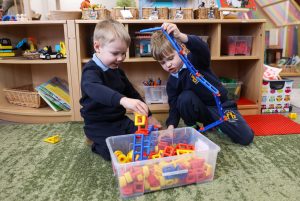
Implementation
We recognise the four guiding principles essential to shaping the practice of our Early Years setting.
- Every child is a unique child, who is constantly learning and can be resilient, capable, confident and self assured
- Children learn to be strong and independent through positive relationships
- Children learn and develop well in enabling environments with teaching and support from adults who respond to their individual interests and needs and help them to build their learning over time. We recognise that children benefit from strong partnership between practitioners and parents
- Children develop and learn at different rates and we need to provide care and an education for all the children in our setting, including children with special educational needs
In planning and guiding children’s learning, we take account of the different ways in which children learn and reflect these in our practice.
Three characteristics of effective teaching and learning are:
- Playing and exploring-children investigate and experience things and ‘have a go’
- Active learning-children concentrate and keep on trying if they encounter difficulties, and enjoy achievements
- Creating and thinking critically-children have and develop their own ideas, make links between ideas, and develop strategies for doing things
Each area of learning and development is implemented through planned, purposeful play and through a mix of child initiated and adult led experiences. As the children progress through the Foundation Stage the balance between child led and adult led changes. Adults plan experiences with particular learning objectives in mind linked to the progress of individuals or groups of children. We recognise that learning occurs when a child makes sense of information and links ideas to existing understanding and so time is given for deepening understanding through exploration and investigation.
Learning through play is an important and integral part of how we teach in the Early Years. We believe that children learn best when they are interested and inspired. We have developed an enquiry based approach to learning where the children are encouraged to pose questions and answer them through their own independent investigations. The adult’s role is to support this through appropriate scaffolding of support. The adults are always on alert for a ‘teachable moment’.
The adults in our setting are experienced in knowing how to help children to learn in many encouraging, thoughtful and gently challenging ways. We create a rich and stimulating environment, indoors and outside, so that children can choose their own play and activities. We join in children’s play where appropriate and sensitively introduce challenges and new ideas. We set challenges for children allowing them to find their own solutions to problems. We model and explain ways of doing things for children. We encourage children to collaborate and learn from each other, guiding children’s learning in a playful way. We introduce new vocabulary, use skilful questioning, and challenge their thinking to help them to progress and clarify their ideas. We directly teach children a new skill, concept or piece of information.
If a child encounters a challenge, they are encouraged not to give up but to be supported to persevere, overcome the challenge and move forward in their learning.
Independent learning and resilience is a challenge for many of the children who begin their journey at St.Paulinus. We find an approach which fosters independence supported by carefully scaffolded challenge really helps our children to progress and develop the skills that they will need to become lifelong learners.
We have a wide range of language ability in children starting at Saint Paulinus. Some children have very limited language and may have already been identified as requiring support from speech and language other children have quite advanced language skills. In order to support both groups of children the acquisition of language has become one of the core elements of our curriculum. It has been recognised that children who are successful learners and communicators grow up to be healthier adults. ‘Strong communication and language skills in the early years are linked with success in education, higher levels of qualifications, higher wages and better health (The Institute of Health Enquiry, 2020). We have recognised the importance of adults modelling high quality language within every area of learning. It is a process which is embedded in our practice and at the forefront of all the interactions we have with children. This includes appropriate technical language in the teaching of maths, science, technology, history, geography and literacy.
We always talk about the learning environment as an additional teacher and strive to ensure that our environment is set up to develop the inspirational and independent learning that we expect in our setting.
The environment is organised to support purposeful play. Enhancements are added either as a result of children’s interests or linked to one of our key high quality texts which are used to inspire and stimulate new learning. As with the outdoor area, the indoor area allows for learning in all areas of development, but the two do not mirror each other. To ensure that the children access all areas of learning and that they acquire the skills and knowledge needed to make progress and become ready for Year One, we also set challenges for the children to complete.
Good quality continuous provision also allows the children to revisit learning and reorganise it in their minds in order to embed and deepen the knowledge and skills that they have acquired.
Resources are organised so that the children can find what they need, access them independently and then tidy them when they have finished. We constantly review and reflect on the environment to ensure that it is effectively enabling the children to make progress.
Mark making equipment is provided in all areas, as are provocations to read. We ensure that our reading areas are as inviting as possible and have provided books in other areas to support learning. We also endeavour to provide opportunities for the children to experience math’s in most areas as this provides the most meaningful math’s experiences for children.
Our key intention is to provide an enabling environment for our children to thrive and grow both emotionally and academically.
At St. Paulinus we recognise that assessment is about individual children and their learning. It is about knowing which children are getting on well, so that they can continue to be challenged and stimulated. It is about everyone in the setting knowing which children might be at risk of poor progress, and giving them extra support and help when needed. This is something we monitor closely through observing and working with children.
Children have a wide range of starting points when they enter our setting so it is important that we assess their level of development on entry. This is done in partnership with parents. With this initial assessment we are able to check that each child is making the best progress they are capable of. We also aim to find out if any of the children have barriers to their learning. We assess them at key checkpoints during their time in the Foundation Stage against our curricular goals. This allows us to identify if any child is falling behind or making poor progress. This then guides planning, resources and possible interventions.