

Maths
At St Paulinus, our curriculum intent is rooted in our mission:
“To love one another, as I have loved you.”
We believe every child is capable of success in mathematics. Mathematical ability is not fixed; with effort, encouragement and the right teaching, all pupils can thrive. Our aim is that every child leaves St Paulinus with the knowledge, skills and confidence to use mathematics in school, in life and in the wider world.
Our Aims
In line with the National Curriculum, our mathematics curriculum enables all pupils to:
-
Become fluent in the fundamentals of mathematics, developing rapid recall and accuracy through regular practice and overlearning.
-
Reason mathematically, following lines of enquiry, exploring relationships and using precise mathematical language to justify and explain thinking.
-
Solve problems by applying mathematics to a variety of contexts, routine and non-routine, breaking down challenges into smaller steps and persevering to find solutions.
Alongside this, we foster:
-
A love of mathematics as a beautiful, creative and universal language.
-
Self-belief and resilience, helping children to approach challenges with confidence.
-
An understanding of the importance of maths in everyday life and future careers.
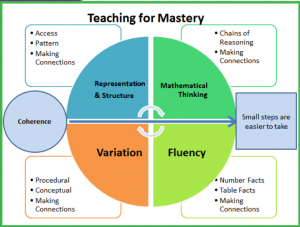
Teaching for Mastery
We teach mathematics using a mastery approach, ensuring that learning is carefully sequenced, coherent and connected. At St Paulinus:
-
We follow the White Rose Maths scheme of learning, enriched with resources from NCETM and Target Your Maths.
-
Lessons are broken into small, manageable steps, building deep understanding of number, place value and the relationships between mathematical concepts.
-
Children move through the curriculum together wherever possible, ensuring equality of access and opportunity.
-
The Concrete–Pictorial–Abstract (CPA) approach is embedded in our practice:
-
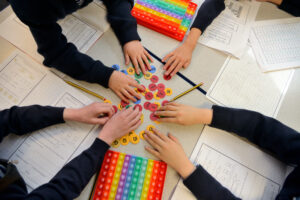
Concrete: using practical equipment to explore new ideas.
-
Pictorial: moving to visual representations.
-
Abstract: applying learning to written symbols and formal methods.
-
-
Mathematical talk is prioritised, with children encouraged to explain their reasoning and articulate their understanding.
Inclusion for All
Our maths curriculum is ambitious for all pupils:
-
Most pupils progress together, with teachers carefully scaffolding learning to support those who need it.
-
Pupils with SEND or gaps in understanding are provided with targeted intervention, pre-teaching and additional practice to secure key knowledge.
-
Pupils working at greater depth are challenged with complex reasoning, open-ended investigations and opportunities to generalise learning.
We believe that every child can succeed in mathematics, and our teaching reflects this high expectation.
Assessment
Assessment is an integral part of mathematics teaching at St Paulinus:
-
Formative assessment happens daily through questioning, retrieval practice and in-class tasks. Teachers adapt lessons immediately to address misconceptions and deepen understanding.
-
Summative assessments are completed each term. Outcomes are discussed in Pupil Progress Meetings to ensure support and challenge are matched to need.
-
Long-term progress is tracked to ensure children are on course to meet end-of-year expectations, with timely intervention for those at risk of falling behind.
Maths in Action
A typical maths lesson includes:
-
Revisiting prior learning to strengthen retention.
-
Explicit teaching of vocabulary and methods.
-
Guided practice, scaffolded with concrete and pictorial representations used before and alongside abstract.
-
Opportunities for partner talk, collaboration and independent application.
-
Variation in tasks to support fluency, reasoning and problem solving.
Beyond the Classroom
We enrich our pupils’ experience of mathematics through:
-
Links with art, science and real-life contexts, helping children see the beauty and purpose of mathematics.
-
Online platforms such as Times Tables Rock Stars support fluency at school and at home.
-
Mastering Number programme (EYFS–Y3) and fluency sessions (Y4–Y6) to ensure secure number sense and rapid recall.
Impact
The impact of our approach is seen in pupils who are:
-
Confident, articulate mathematicians with secure conceptual understanding.
-
Able to use mathematical vocabulary with accuracy and pride.
-
Resilient problem solvers who persevere when faced with challenge.
-
Well-prepared for the next stage of their education and equipped to use mathematics throughout their lives.
At St Paulinus, we build strong foundations so that every child leaves us not only proficient in mathematics, but also with the curiosity, confidence and love of learning that will carry them far beyond primary school.